- Home
- Works & Tech
- How Will Physical AI Enter Construction Sites? Key Points of MLIT's Physical AI Strategy for the Construction Sector
Tech ArticlesSimulationAI
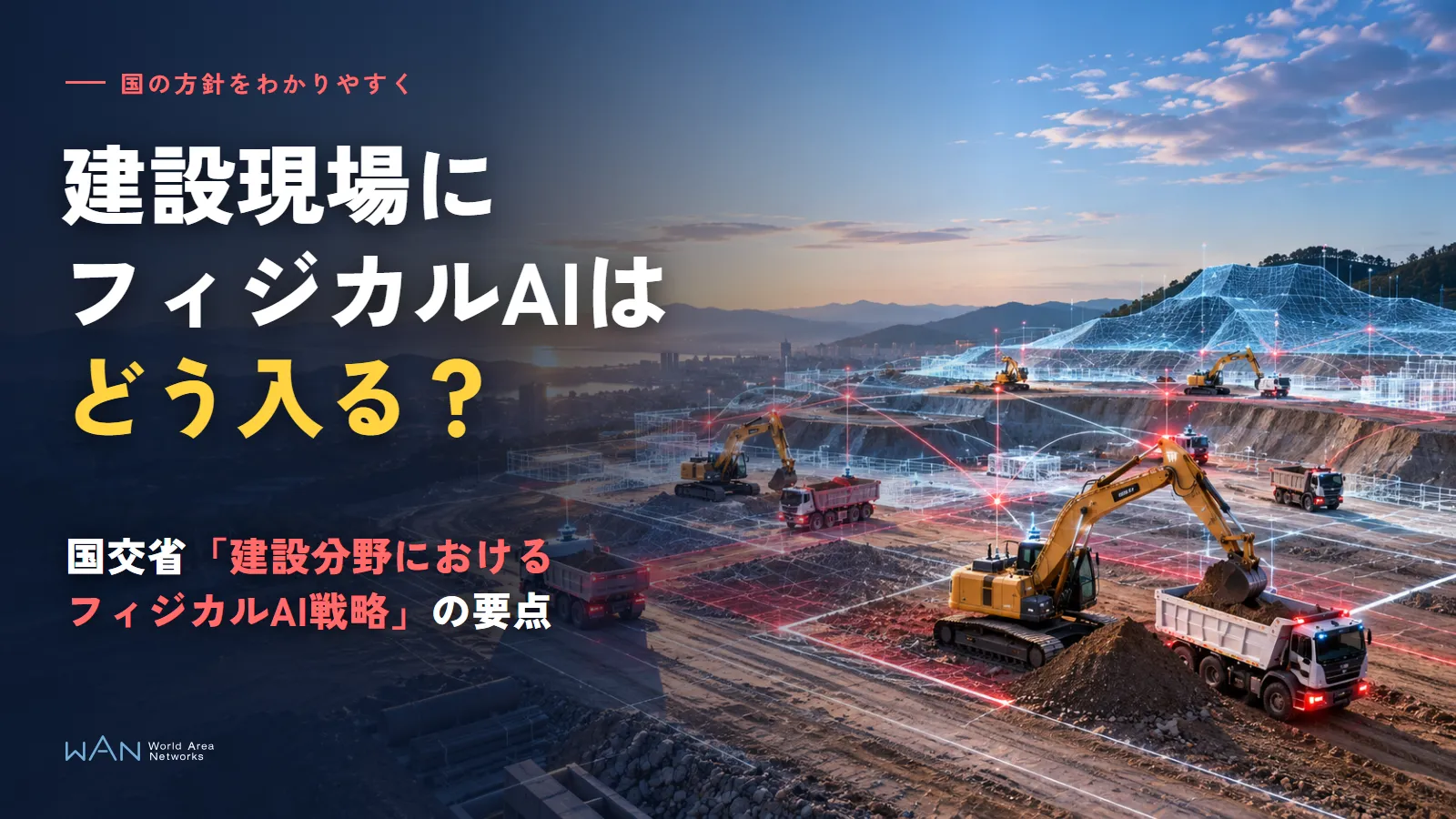
How Will Physical AI Enter Construction Sites? Key Points of MLIT's Physical AI Strategy for the Construction Sector
What the interim summary says, how it relates to i-Construction 2.0, and what construction companies, machinery manufacturers, and developers can prepare now
On September 4, 2026, Japan's Ministry of Land, Infrastructure, Transport and Tourism (MLIT) published the "Physical AI Strategy for the Construction Sector (Interim Summary)." Covering construction work such as rivers and roads, it sets out the approach to bringing physical AI onto sites, how development and deployment will proceed, and eight fields to prioritize. On October 9, MLIT also began recruiting members for the industry-academia-government "Physical AI Consortium for the Construction Sector," which is based on this strategy.
For construction companies, construction machinery manufacturers, and developers of AI and simulators, the document shows which tasks the government intends to automate first, and with what kind of organization. However, because it is an interim summary, MLIT states that it will revise it based on further discussion and on-site demonstrations. The following reflects the content as of September 2026.
Key points
Positioning: Taking the goals of i-Construction 2.0 further with AI
Keeping the workforce-reduction target for FY2040, the strategy aims to use physical AI to overcome the non-routine nature of sites that ICT alone has struggled with.
Learning environment: Keep improving with simulators and site data
On the premise that gaps between the virtual and the site (Sim-to-Real) will arise, it is considered important to keep improving simulators and AI with data from demonstrations.
Collaboration: Building shared foundations through a consortium is getting started
Construction companies, construction machinery manufacturers, AI developers, universities, and others will gather to discuss data specifications and evaluation criteria.
01What Is the Physical AI Strategy for the Construction Sector? Background and Positioning
The strategy defines physical AI as a system in which the physical environment is perceived through sensors and other means, AI reasons and makes decisions according to the situation, and machines or robots act in physical space based on the results.
The background it cites includes labor shortages, preparing for earthquakes and wind and flood damage, extreme summer heat, and aging infrastructure. The strategy then identifies as a structural obstacle to automation the fact that construction sites are built to order as one-off projects and depend on terrain and construction conditions, so work is highly non-routine and uncertain. Its view is that spreading ICT and robotics alone has limits in overcoming this obstacle, and that advances in AI such as VLA (vision-language-action models) mean the social implementation of physical AI is entering a realistic stage.
In terms of positioning, it puts into concrete form "introducing physical AI and similar technologies on site," one of the three pillars of "MLIT's Policy for AI Implementation in the Infrastructure Field," which was formulated at the same time. The government's "AI Robotics Strategy" (formulated by an inter-ministerial liaison conference in March 2026 and partially revised in May) also names construction and civil engineering as one of the target fields for social implementation. On the timeline, the strategy sets around 2030 as the short term and around 2040 as the medium to long term, and says it will push ahead with on-site demonstrations early to achieve short-term results.
| Chapter | What it covers |
|---|---|
| 1 Introduction | Background, definition of physical AI, positioning of the strategy |
| 2 Future vision of construction sites | Conditions in the construction sector, AI advances, short- and medium-to-long-term timelines |
| 3 Basic approach | Relationship with people, starting from problems, co-creation, spread to small and medium-sized companies, rethinking design |
| 4 Approach to development and deployment | Organization, technical structure and shared foundations, demonstration environments, evaluation and standardization, workforce development |
| 5 Priority fields | Eight fields from machine-based construction to disaster recovery |
02How Are i-Construction 2.0 and the Physical AI Strategy Connected?
"i-Construction 2.0," formulated by MLIT in April 2024, aims to reduce the workforce needed on construction sites by at least 30% (a 1.5-fold increase in productivity) by FY2040, with automation of construction work, data integration, and construction management as its three pillars. Rather than setting a separate goal, the Physical AI Strategy states that physical AI can be a means of overcoming the structural obstacles and can take i-Construction 2.0 further. On how to proceed, it also says it will use the knowledge gained from on-site implementation of i-Construction 2.0, such as ICT construction Stage II and automated and remote construction.
| Item | i-Construction 2.0 | Physical AI Strategy for the Construction Sector |
|---|---|---|
| Published | April 2024 | September 2026 (interim summary) |
| Goal | Workforce reduction of 30% and 1.5-fold productivity by FY2040 | Supports the same goal with physical AI |
| Pillars | Automation of construction work, data integration, and construction management | Organization, shared foundations, demonstration environments, evaluation and standardization, workforce development |
| Main means | ICT construction, automated and remote construction, data integration | AI that perceives situations and makes decisions, simulators, site data |
What connects the two is data. The strategy positions construction data, sensor data, and the operation logs of experienced operators as important data assets for AI training.
Marketer's note
ICT construction data tends to stay in each site's folder once the as-built inspection is done. To use it for AI training, you need to be able to tell later which machine it came from, when, and under what conditions. Listing where your company stores its construction data and operation logs, and in what formats, shows how much is usable and what information is missing.
03Basic Approach of the Physical AI Strategy and the Eight Priority Fields
Chapter 3 of the strategy sets out five principles for using physical AI.
- Support people and extend their abilities: It is meant to make experts' knowledge usable at more sites, and the strategy states that it is "not a substitute for the final decisions and responsibilities that people should bear"
- Do not make adoption itself the goal: Start from the problems and constraints on site, and combine AI, robotics, and ICT
- Co-create with diverse players: AI developers and universities join construction companies, construction machinery manufacturers, construction consultants, surveying companies, and others
- Spread to the sites of small and medium-sized companies too: Look beyond large projects to sites that support local communities
- Rethink design and construction methods: Designers and builders work together to build shapes and procedures that are easy for robots into the design
In Chapter 5, eight priority fields are selected based on their contribution to the labor shortage, safety, and skills transfer, whether data and learning environments can be prepared, and how urgent the social need is.
| Field | Target work | Direction in the reference materials (summary) |
|---|---|---|
| 1 Machine-based construction | Earthwork excavation, hauling, spreading, and loading | Coordinated construction, including retrofitting existing machinery |
| 2 Manual skilled work | Rebar placement and tying, formwork assembly and removal | AI-assisted construction support and partial automation |
| 3 On-site short-distance hauling | Hauling materials and waste within the site | Deployment of hauling robots and coordinated hauling with multiple units |
| 4 Structure inspection | Road and river structures | Anomaly detection and deterioration diagnosis with drones, quadruped robots, and AI |
| 5 Patrol and inspection | River patrols, road patrols | Measuring deformation through autonomous movement and judging response priority |
| 6 Weeding, snow removal, cleaning | Vehicle-type machinery and manual work | Automatically generating work plans from sensing and working autonomously |
| 7 Disaster surveys | Wide-area and detailed surveys | Autonomous surveys of hazardous areas people cannot enter |
| 8 Disaster recovery | Debris removal, grading, clearing roads, etc. | Autonomous AI control of unmanned and remote construction machinery, and integrated management of multiple machines |
The specific tasks and approach for each field will be studied by the collaborative organization to be set up.
04Five Pillars of the Approach to Development and Deployment
Development in the priority fields proceeds as a cycle: existing technologies are first used at test fields and similar sites, and are improved with the data collected there. The strategy lists the following five concrete measures.
| Pillar | Main content |
|---|---|
| Development and deployment organization | Form a consortium of construction stakeholders, AI developers, universities, and government, and set up project teams for high-priority issues |
| Technical structure and shared foundations | Collect and share four types of data: training, demonstration, evaluation, and site data. Make construction machinery and other equipment AI-ready, and build development structures like the Public Works Research Institute's automated construction platform OPERA |
| Demonstration environments | Run long-term demonstrations using national research institutes' DX experiment fields, private test sites, and parts of actual construction sites |
| Evaluation and standardization | Study measures for performance evaluation, data specifications, safety design frameworks, and standardization of interfaces |
| Workforce development | Develop people who can choose AI suited to a site, use it well, and maintain it, including at small, medium-sized, and specialist contractors |
What matters most to readers is the policy of separating "cooperative areas" the industry aligns on from "competitive areas" where each company competes. Examples of cooperative areas are standardizing data formats, interfaces, and communication specifications, and systems and standards for quality, safety, and cost. Competitive areas include AI models using 3D data and other data, commercializing construction robots, and construction planning software.
05Simulators, Sim-to-Real, and How Data Is Handled
How AI is to be trained is described concretely in the "technical structure" part of Section 4-2.
Build the learning environment as a cycle of simulators and demonstrations
The strategy organizes physical AI from three angles: (1) the work to be supported or replaced (goals and targets), (2) how AI decisions are combined with conventional machine control (implementation and control method), and (3) how it learns and improves (learning environment). For (3), it considers it important to keep improving simulators and AI models with data collected in on-site demonstrations and to build a cycle of rapid, repeated improvement between virtual space and actual sites. The idea is that differences between simulation and real machines (Sim-to-Real) will arise, and that they should be narrowed to a level acceptable in practice. The government's AI Robotics Strategy (March 26 version) also calls this difference the "Sim2Real gap," states that it can be a barrier to social implementation, and says it will develop simulation environments and verification environments close to real sites as one package.
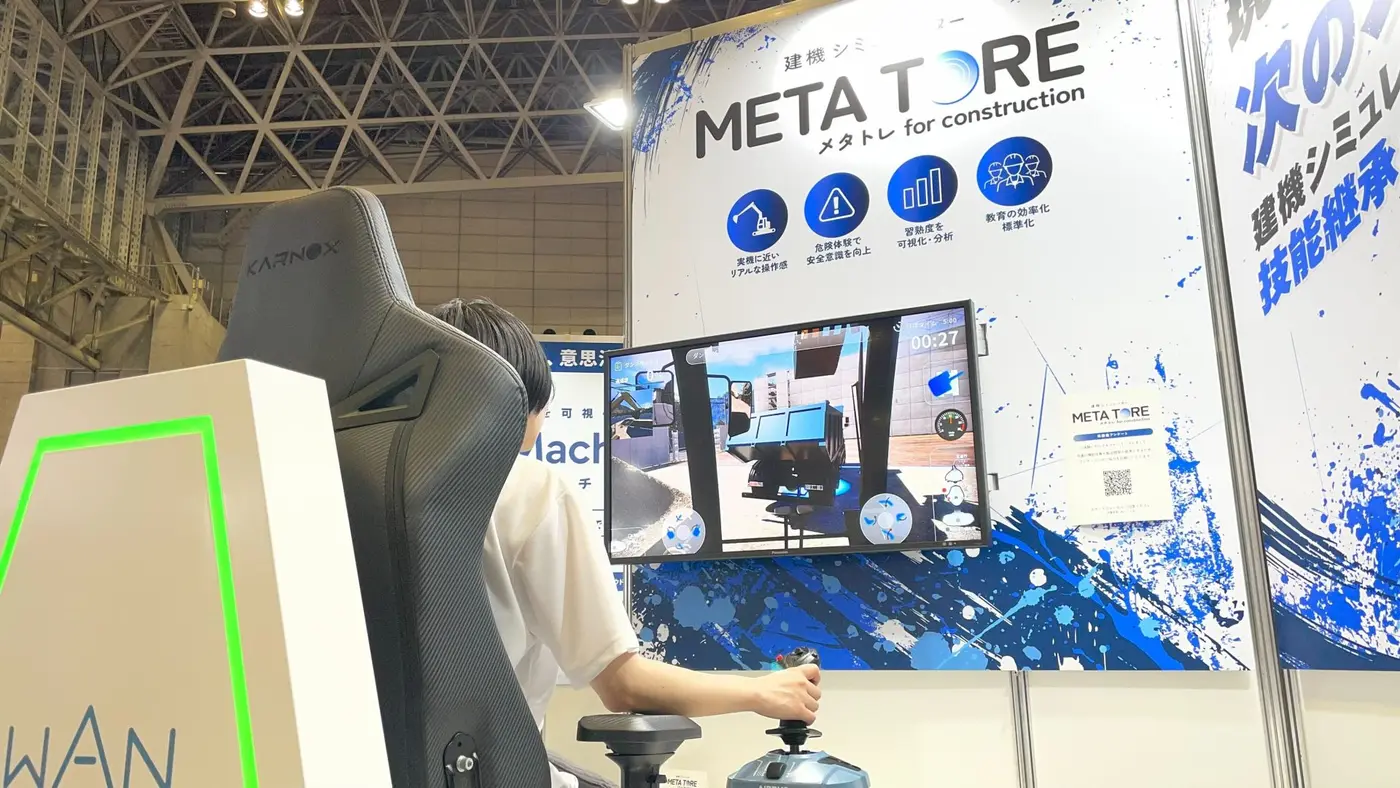
Even for the same construction machinery simulator, what must be matched to reality differs between simulators for human training and simulators for AI training. The difference, and how to reduce the Sim2Real gap, are explained in Can AI Learn in a Virtual Space That Doesn't Match Reality? Simulation Environments for Training Physical AI.
Sort out data types and handling rules first
The strategy says it will turn the reasoning and work procedures of experienced engineers and skilled workers into data using sensors and other means, and systematize them. Examples given in the reference materials are construction data, operation logs, point clouds that follow the progress of work, recorded video, and data such as weather. It also considers it important to sort out in advance, through the consortium and other bodies, the quality standards, ownership, use, and disclosure scope of data collected on site.
Marketer's note
Discussions about simulators often start with how the virtual space looks. What the strategy emphasizes, though, is the mechanism for continually correcting the simulator with demonstration data. Deciding first what data can be recorded on the real machine and which items to compare with the virtual side also makes it easier to define the simulator's specifications.
06What Construction Companies, Machinery Manufacturers, and Developers Can Do Now
The specifics of the strategy will be decided by the consortium from here on. According to the application guidelines, a Construction Machinery PT and a Manual Work Support PT (project teams) will be set up first to study target tasks, the level to be reached around 2030, and requirements for data specifications, simulators, and demonstration environments, and to draft specifications and guidelines.
| Timing | Schedule |
|---|---|
| October 9 – November 6, 2026, 17:00 (JST) | First call for members (general members and project members) |
| Late November 2026 (planned) | First consortium general meeting |
| After the first general meeting | Rolling recruitment (project members are subject to review, so decisions may take time) |
Construction companies: Take stock of site problems and data
Mapping the tasks at your sites that lack workers or are dangerous onto the eight priority fields shows where you fit into the discussion. Checking where your construction data and operation logs are kept will also give you material for joining demonstrations.
Construction machinery manufacturers: Prepare for AI-readiness and common interfaces
The strategy lists making construction machinery AI-ready as a shared-foundation measure, and standardizing communications and interfaces as an example of a cooperative area. It is a good idea to discuss internally, ahead of time, where to align with the standards and where to differentiate with your own products.
Developers: Be ready to propose simulators and verification mechanisms
The areas where AI and simulator developers can most easily get involved are the learning environment and shared foundations. Being able to explain not just a standalone simulator but the whole flow of checking and correcting the gap between virtual and real machines with demonstration data makes it easier to team up with other companies.
Marketer's note
Your technologies, the target tasks you want to work on, and your role in the team are the three items to fill in when applying for project membership. Materials that explain in-house technologies in terms outsiders can understand are surprisingly rare. Summarizing your technologies and the industries of the partners you want to work with on a single page is useful both for the call for members and for meetings with other companies.
07Summary: Read the Construction Physical AI Strategy in Terms of Positioning, Learning Environment, and Collaboration
The Physical AI Strategy for the Construction Sector will be revised based on discussions in the consortium and on-site demonstrations. Even so, it can be read along the following three axes.
Positioning: Read it as the next means toward the goals of i-Construction 2.0
The goal remains a 30% workforce reduction and 1.5-fold productivity by FY2040, and physical AI is a means of getting there. Rather than drawing up a new plan from scratch, positioning it as an extension of your ICT construction efforts makes it easier to explain within your company.
Learning environment: Prepare on the premise of continually correcting simulators with site data
A cycle of improvement using demonstration data is required, on the premise that gaps between the virtual and the site will occur. Align your company's thinking early on what data to record and its ownership and disclosure scope.
Collaboration: Follow the consortium's discussions and consider taking part
Drafts of data specifications and simulator requirements will be prepared by the project teams. The first call for members runs until November 6, 2026, and rolling recruitment is planned afterward.
We recommend mapping your sites' problems onto the eight priority fields, compiling a list of the data you record, and then deciding internally whether to join the consortium.
Sources and references
Ministry of Land, Infrastructure, Transport and Tourism, "Physical AI Strategy for the Construction Sector (Interim Summary)" (September 2026, in Japanese) https://www.mlit.go.jp/tec/constplan/content/002020333.pdf (accessed October 27, 2026)
Ministry of Land, Infrastructure, Transport and Tourism, "Physical AI Strategy for the Construction Sector (Interim Summary): Reference Materials" (September 2026, in Japanese) https://www.mlit.go.jp/tec/constplan/content/002020335.pdf (accessed October 27, 2026)
Ministry of Land, Infrastructure, Transport and Tourism, press release on the formulation of "MLIT's Policy for AI Implementation in the Infrastructure Field" and the "Physical AI Strategy for the Construction Sector" (Interim Summary) (September 4, 2026, in Japanese) https://www.mlit.go.jp/report/press/kanbo08_hh_001361.html (accessed October 27, 2026)
Ministry of Land, Infrastructure, Transport and Tourism, press release on recruiting members for the "Physical AI Consortium for the Construction Sector" (October 9, 2026, in Japanese) https://www.mlit.go.jp/report/press/kanbo08_hh_001367.html and its press materials (including the application guidelines) https://www.mlit.go.jp/report/press/content/002026395.pdf (accessed October 27, 2026)
Ministry of Land, Infrastructure, Transport and Tourism, "Construction Work and Construction Machinery: Introducing Physical AI in the Construction Sector" (in Japanese) https://www.mlit.go.jp/tec/constplan/sosei_constplan_tk_000036_00001.html (accessed October 27, 2026)
Ministry of Land, Infrastructure, Transport and Tourism, press release on the formulation of "i-Construction 2.0" (April 16, 2024, in Japanese) https://www.mlit.go.jp/report/press/kanbo08_hh_001085.html (accessed October 27, 2026)
Inter-Ministerial Liaison Conference on AI Robotics, "AI Robotics Strategy" (March 26, 2026, in Japanese) https://www8.cao.go.jp/cstp/ai/ai-semi_wg/2kai/siryo4_2.pdf (accessed October 27, 2026)

Consultation
Development of simulation environments for AI training
We develop simulation environments usable for AI training, from 3D measurement of sites to reproducing the virtual space, machines, and sensors. We also welcome consultations at the concept stage and about joint research.